Lesson 5. Prepositions and phrasal verbs
Prepositions – which include all those little words such as in, on, ca, for, and by – are difficult words for language learners since they do not appear to operate according to a clear set of rules. They are often used idiomatically with verbs and adjectives, and a preposition used with a verb can even change the meaning of the verb. Since there are many hundreds of prepositional phrases you should keep a preposition notebook or a section in a notebook and each time you come across a new usage, make a note of it.
Prepositions of Location
1. Prepositions can be used to describe how one thing is located in relation to another.
on the table, at the table, next to the table, under the table.
2. Another important use of propositions is to show where something is located in a space. Look at the diagram below to see how prepositions are used to describe location on a page.
in the comer
at the top/bottom
in the center/middle
on the side
a = in the upper left corner
b = at the top of the page
c = іn the upper right comer
d = on the left hand side of the page
e = in the center/middle of the page
f = on the right hand side of the page
g = in the lower left corner
h = at the bottom of the page
і = іn the lower right corner
3. Note the following common uses of at to describe a location.
at home, at school, at work, at a party, at the post office
4. Note the following common uses of on to describe a location.
on the fifth floor, on a farm, on a bicycle, on a train
5. Note the following common uses of in to describe a location.
in bed, in jail, in a picture, in a mirror, in one's hand, in the water, in the newspaper, in the front row, in a car, in a taxi
6. The prepositions at, on, and in are also used to describe someone’s address.
at + specific address (He lives at 950 Collins Si reel, Tacoma.)
on + a street (He lives on Collins Street.)
in + a city, state, and country (He lives in Tacoma/in Washington/ in the United States.)
Prepositions of Time
The prepositions at, on, and in are also used to indicate time and are frequently confused.
1. The preposition at is used with a specific time of the day.
He got up at 6 o'clock.
2. The preposition on is used with days of the week and dales.
John Fitzgerald Kennedy was assassinated оn November 22, 1963.
The preposition in is used with parts of the day, months, seasons, years, a time in the future.
Madame Curie won her second Nobel Prize in 1911.
The scientists will be presenting their report in a week.
You can say in the morning, but if you state the specific day of the week, you must use the preposition on ~ on Saturday morning.
Another exception is the use of at with night – at night.
Note you say get into and out of a car or a taxi, but get on and off a bus or train.
Note that the following expressions of place and direction using the noun home include no prepositions: to go home, to arrive home, to be/stay home.
Task 1. Insert an appropriate preposition in the following sentences.
1. She is living _______ Denver, Colorado.
2. Her parents live _____ the same street.
3. Her brother lives ____ 356 Clinton Street.
4. He knocked the glass __ the table and it smashed on the the floor.
5. It often rains __ the afternoon.
6. It often rains ___ night.
7. She got ___ the bus ___ the library.
8. They signed the document ___ the lower right-hand corner.
9. _________ Thursday, he sat _his desk and put his papers ___a drawer.
10. He wrote his name ___ the top of a sheet of paper ___his desk.
Task 2. Use these words or groups of words to complete this page. The first or the last letter is given.
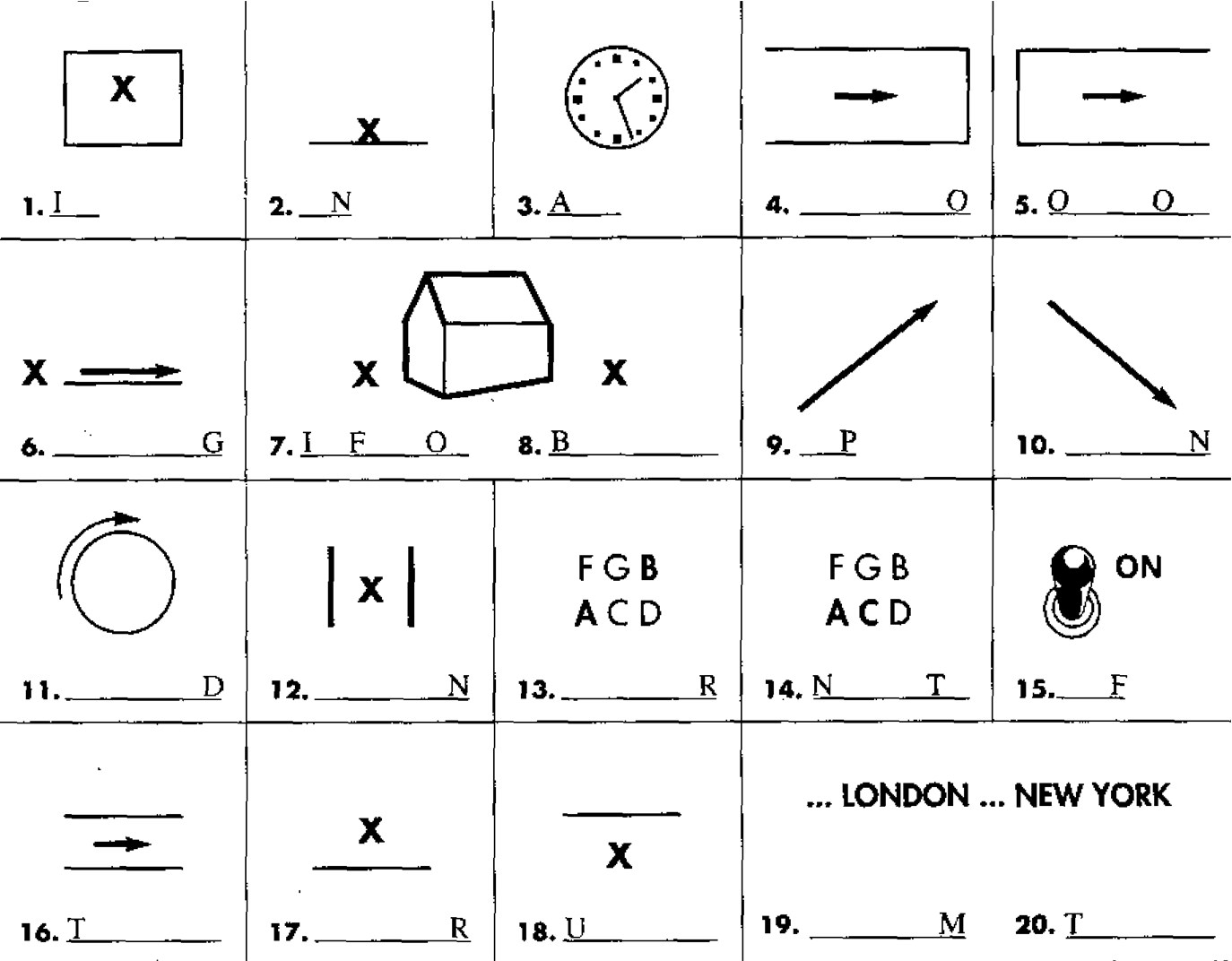
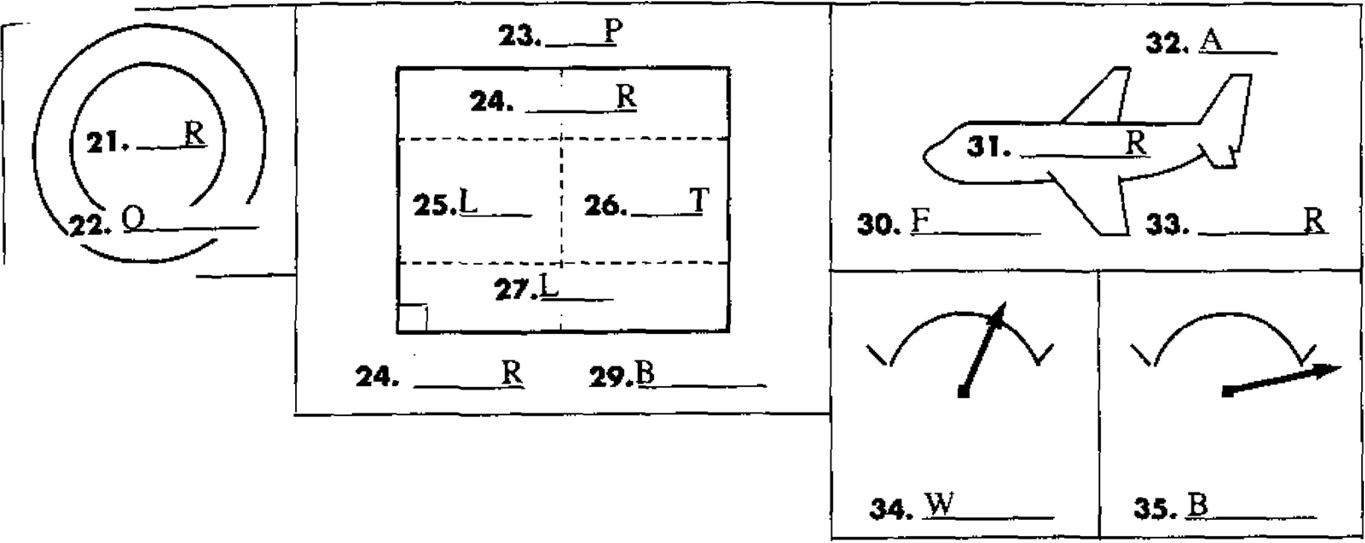
Tricky Prepositions
1. Since indicates a point in lime at which something started. For indicates I he length of a period of time. During indicates that something occurred at some time within a period.
I have lived in New York since 1994.
I lived in St. Louis for ten years.
During the time I lived in St. Louis, I got married.
2. Near indicates general proximity. Next to indicates more direct proximity. They live near each other. (They live a few blocks apart.)
His house is next to mine. (They live in adjoining houses.)
3. Between indicates a position relative to two markers. Among indicates a position relative to more than two.
The file cabinet is between the computer and the fox machine.
The document is among my papers somewhere.
4. By is used with a point in time, a deadline; it is the equivalent of no later than.
Until is used with a point in time also; it indicates the end point of an action.
We have to register by August 28.
She was reading until midnight.
Task 3. Write four questions to ask classmates that force them to answer by using one of each of the sets of "tricky prepositions" in item D.
Example: How long have you been studying English?
Answer: I've been studying English for twelve years.
Prepositions Following Verbs and Adjectives
1. Certain verbs are frequently followed by prepositions. Here are some common combinations.
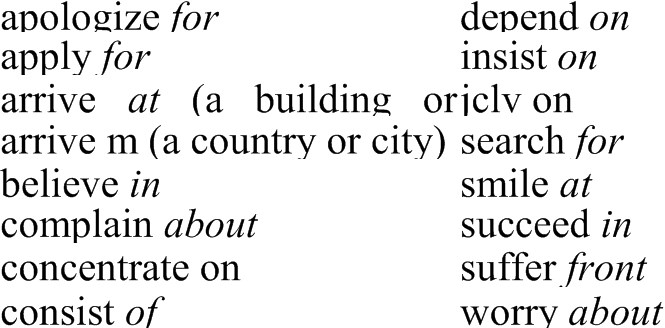
2. Some verbs are followed by a direct object and a preposition. Add to ibis list whenever you can.
blame someone for something congratulate someone on something explain something to someone protect someone from something thank someone for something
throw something at someone (intending to hit the person)
throw something for someone (intending it to be caught)
Phrasal Verbs
Although prepositions are little words, they are packed full of meaning. In fact, one of these little words attached to a verb can completely change the meaning of the verb. When a preposition is attached to a verb in a certain way the preposition is known as a "particle,” and the verb is known as a ’phrasal verb” or a ‘two-word verb.” Phrasal verbs are used more in conversation and informal writing; in formal and scientific writing, one-word equivalents are more common.
1. The combination of verb + particle takes on a new idiomatic meaning, often quite far from the meaning of the verb alone.
put off = postpone; put out = extinguish
She put off going to the dentist.
He put out the flames with a bucket of water.
2. Some phrasal verbs are separable, which means that the particle can be placed after the direct object as well as before it.
He filled out the form.
He filled the form out.
When the object is a pronoun, then you must use it to separate the verb + preposition phrase.
When you want to know the meaning of a word, look up it.
Some phrasal verbs are used with a particle and a preposition, making in effect a three-word verb. These phrasal verbs arc inseparable, which means that the direct object cannot come between the verb and the particle or preposition.
I can't put up with that noise any longer’
The whole office staff саmе down with the flu last winter.
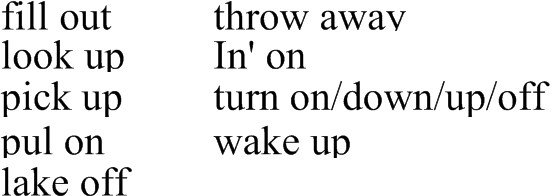
Some examples of separable phrasal verbs are.
Task 4. Choose a preposition or particle to fit into each blank.
1. Before she went to bed, she turned ___ the lights.
2. I’ll write the report ___ next Tuesday. That's a promise.
3. He is looking forward ___ seeing his nephew when he visits his sister next week.
4. He didn’t turn _______ at work, so the meeting had to be called.
5. When my daughter was sick, Nora’s sister offered to help look __ her.
6. They called to congratulate him ___ winning the prize.
7. They wanted to watch TV, so I turned it ___ immediately.
8. He explained ___ me why I had to stay and work ___nine o’clock ___the evening.
9. He said he thought he could rely ___ me, but then he apologized _ asking me to work late two nights in a row.
10. However, I decided not to complain ___ the boss ___ my long working hours.
Task 5. Choose the correct words in italics. If both options are correct, choose both
THE EDEN PROJECT
NO, YOU'RE NOT looking at a scene (1) from/ out of a James Bond movie!
The futuristic buildings in this photo really exist. They are part of the Eden Project – one of the most spectacular of the Millennium projects.
The Eden Project is located (2) at/iп Cornwall, England, in a former clay pit (3) above / over 50 metres deep. It consists of several huge domes, a large open area and a visitor centre. The Eden Project functions (4) as/ like a 'storeroom' for a huge number of plants from all over the world. The two main domes store plants and trees (5) from/ for the tropical and temperate regions of the world, while the open area accommodates more local species.
The Eden Project has many other functions (6) against/ besides that of a storeroom, however. It is a centre for education, art and science, showing us ways in (7) which/ that plants are vital to the world's existence, and promoting understanding of the delicate balance (8) between/ among using and conserving plant life. As well as (9) provide/ providing a focus both for scientific research and for education, the project includes exciting experiences for children, such as walking (10) through
Более 800 000 книг и аудиокниг! 📚
Получи 2 месяца Литрес Подписки в подарок и наслаждайся неограниченным чтением
ПОЛУЧИТЬ ПОДАРОКДанный текст является ознакомительным фрагментом.